
Eco-Cycle's 50th Anniversary
Eco-Cycle's 50th Anniversary
Fifty Years of Proving What’s Possible: Eco-Cycle Celebrates a Half-Century of Community-Based Zero Waste Innovation
The Boulder County-based nonprofit helped birth Colorado’s recycling and Zero Waste movements — and it’s not done yet
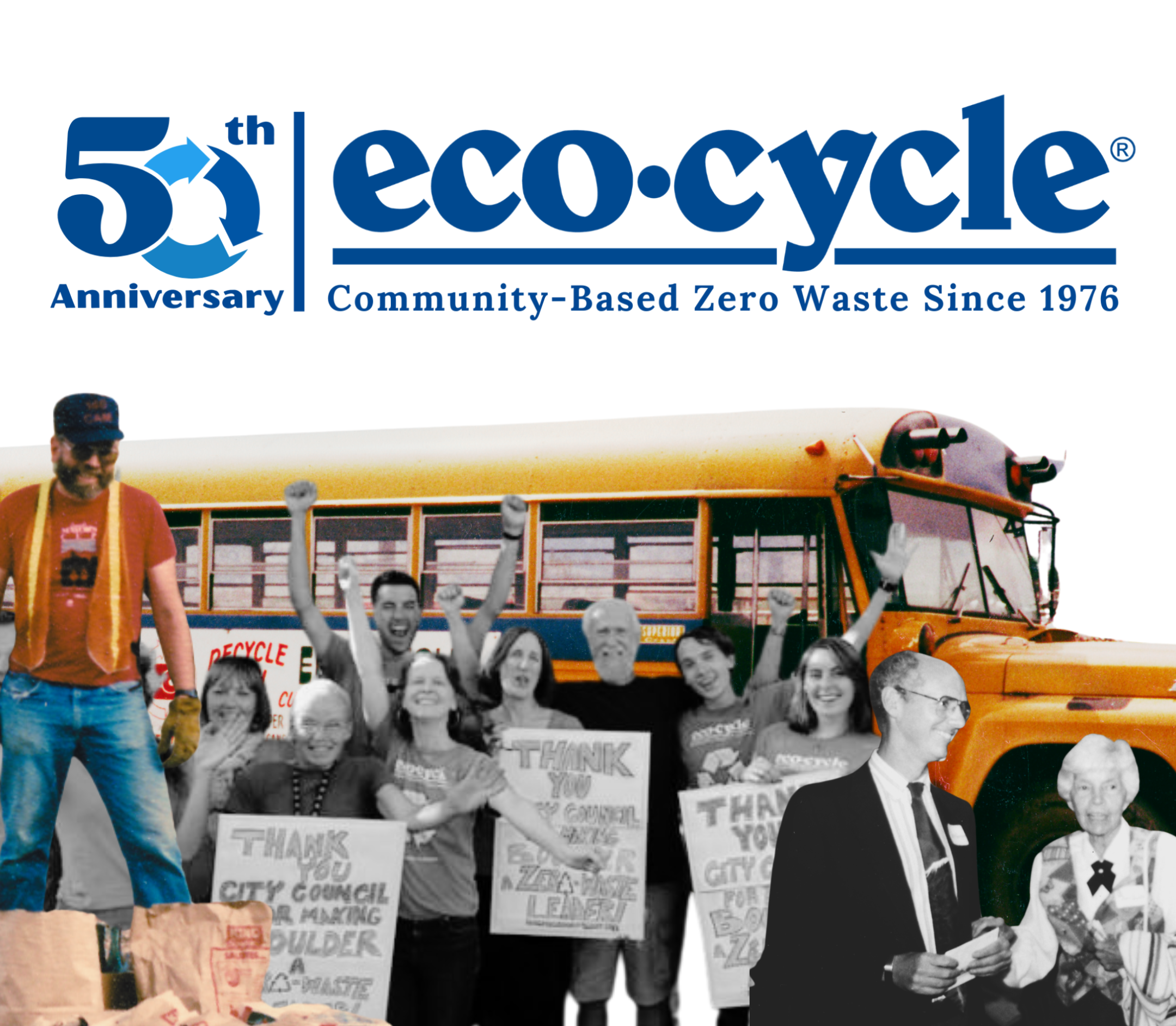
BOULDER, Colo. — In 1976, a small group of Boulder residents did something radical: rather than waiting for government or industry to fix the way society was discarding and destroying natural resources, they took matters into their own hands. Founders Pete Grogan and Roy Young—both 25 years old, backed by a network of community movers and shakers including many elder women leaders—bought retired school buses, staffed them with volunteers, and started driving neighborhood to neighborhood collecting glass, aluminum, and paper. That grassroots act of collective vision and action became Colorado's first curbside recycling program—and the spark that grew into Eco-Cycle, one of the nation's oldest and largest nonprofit recyclers, which marks its 50th anniversary in 2026.
Half a century later, the recipe for systems change hasn’t varied: Eco-Cycle works with partners across every sector of the community — residents, government, businesses, schools, and farmers — willing to try something different and help shift our relationship with natural resources from throwaway to stewardship.
“That solemn duty and obligation to save our planet starts here at home. And there is no organization, I believe, in our country that is doing a better job of that than Eco-Cycle.” — U.S. Congressman Joe Neguse, 2022
A String of Colorado Firsts, Each Built with Community
The pattern of innovation that started with those school buses has never stopped. In 1979, Eco-Cycle opened the first Materials Recovery Facility in the Rocky Mountain region, creating the infrastructure to sort and market recyclables at scale. That same year, Eco-Cycle launched what would become the Eco-Leader Volunteer Network — training engaged residents as peer educators who carry the Zero Waste message neighborhood by neighborhood, and who have since become a cornerstone of civic culture across the region.
In 1984, in partnership with local government and schools, Eco-Cycle launched what became the nation’s first science-based, preschool-through-12th-grade Zero Waste school program. Today, Eco-Cycle’s award-winning Green Star Schools program and Environmental Education programs combined reach more than 75 schools across Boulder, Broomfield, and parts of Jefferson counties. Zero Waste collection systems within Green Star Schools support students in recycling and composting an average of two-thirds of their waste, and students receive in-classroom education on topics ranging from recycling to rainforest ecosystems. Over the decades, hundreds of thousands of young people have grown up with environmental literacy and Zero Waste as a way of life.
In 1994, Eco-Cycle initiated and helped pass a ballot measure to create the public funding that built the Boulder County Recycling Center (BCRC). Also in 2001, a partnership with the City of Boulder produced the Center for Hard-to-Recycle Materials (CHaRM), the first facility of its kind in the United States — a place where electronics, appliances, mattresses, and 23 other materials can now be recovered. Owned by the county and operated by Eco-Cycle, the BCRC now processes some of the highest-quality recyclables in the nation, and the CHaRM model has since been replicated in communities across the country.
More recently, Eco-Cycle has partnered with farmers across Boulder County to close the loop on composting through its Farmer First program. Organic material collected from schools and businesses that have achieved “clean generator” status — meaning they’ve done the hard work of keeping their waste streams uncontaminated — is returned to the soil, and the program is piloting carbon farming practices that draw carbon back from the atmosphere. Eco-Cycle is also leading the hauling industry’s transition to zero emissions, operating the nation’s first EV commercial compost truck — with several more slated to join the fleet.
And at the statewide level, the organization played a central role in advancing Colorado’s Producer Responsibility legislation for paper and packaging — a landmark law that, when fully implemented, will make recycling free for all Coloradans and aims to at least double Colorado’s recycling rate from 15% by 2030.
A Model for How Change Actually Happens
Across five decades, what Eco-Cycle has demonstrated—again and again—is a theory of change rooted in community. No single milestone happened in isolation. Each one required partners willing to try something new: a neighbor putting glass bottles at the curb, a school district saying yes to a composting pilot, local governments willing to help create new Zero Waste infrastructure, farmers agreeing to process organic discards into finished compost to use on their land, state legislators willing to shift the cost of packaging waste from consumers to the corporations that create it.
Creating new programs, policies, and infrastructure that help shift systems from resource destruction to circular economies is the story Eco-Cycle has been writing since 1976. These systems matter enormously for the climate: according to the EPA, materials and food systems account for more than 42% of U.S. greenhouse gas emissions.
“Eco-Cycle is a community institution in the truest sense — it was built by this community, for this community, and it helps define this community,” said Eco-Cycle Executive Director Suzanne Jones. “The work we’ve done together over fifty years is creating a new normal in Colorado and beyond around how we view and use our precious natural resources. Our job now is to make sure the next generation inherits the systems they will need to thrive — systems that protect the climate, natural resources, habitats, and people."
Celebrating 50 Years — and What Comes Next
Throughout 2026, Eco-Cycle will host anniversary events celebrating the community partners and innovators who helped build the systems Colorado now relies on. The organization also looks ahead: with new challenges in plastics reduction, expanded composting infrastructure and carbon farming, increasing the fleet of EV trucks, expanding access to hard-to-recycle material recovery in more communities, and ongoing statewide policy campaigns, the next chapter is already underway.
To learn more, get involved, or attend anniversary events, visit www.ecocycle.org/50-years
About Eco-Cycle: Founded in 1976, Eco-Cycle is one of the nation’s oldest and largest nonprofit recyclers. Based in Boulder County, Colorado, the organization operates the Boulder County Recycling Center, the Eco-Cycle/City of Boulder Center for Hard-to-Recycle Materials (CHaRM), and the award-winning Green Star Schools and Eco-Leader programs. Eco-Cycle innovates, implements, and advocates for local and global Zero Waste solutions to foster a more regenerative, equitable, and climate-resilient future.